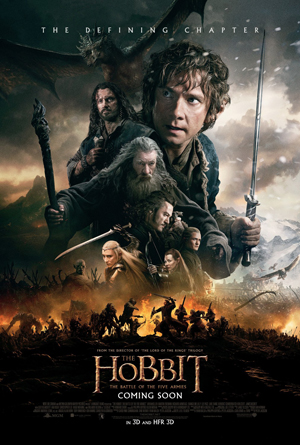
Thursday, February 5, 2015

Epic? Yeah. Defining Chapter? Yeah Right...


Final installment in Hobbit Trilogy is as epic as you’d expect.

Peter Jackson’s three-part adaptation of J.R.R. Tolkien’s The Hobbit has overall proven to be less than what it could have been.  The first installment, An Unexpected Journey, had a nice blend of Tolkien’s original tale and additional content connecting it to The Lord of the Rings.  The next installment, The Desolation of Smaug, didn’t blend the two parts of the saga so well: when the focus was on the main story, progression was smooth and engaging.  But when it shifted focus to the subplots, the movie dragged along, making me roll my eyes (and don’t even get me STARTED on the most evil cliffhanger in the history of evil cliffhangers).  The redeeming factor, of course, was the subtitle character and primary antagonist of the original story: Smaug the Magnificent (excellently voiced by Benedict Cumberbatch), and oh boy, was he magnificent!  Hands down, this is the best CGI dragon in the history of live-action cinematic dragons.

Now we have The Battle of the Five Armies, the long-awaited conclusion that, like Smaug’s live-action incarnation, lives up to the hype surrounding it.  Starting out, while the second movie showed us the magnificence of Smaug, this movie’s opening, picking up immediately where the second one left off, shows us why this magnificent creature is so feared...and it delivers, as Smaug here is, to quote my older brother, “terrifying.”  Of course, that only lasts for the first five minutes, as he’s shot through that hole in his armor before the movie’s subtitle shows up, conveniently falling on top of the destroyed Lake Town’s fat, power-hungry leader, killing him.

With the dragon dead and winter quickly approaching, Bard, now leader of the townsfolk, places his hope and trust in Thorin Oakenshield, rightful King Under the Mountain, who promised the townsfolk that when the dragon was dead they would share the spoils with them.  But Thorin, now holding full control over the mountain, is obsessed with finding the Arkenstone, a precious gem his fathers handed down and treated as the emblem of their kingdom while driving them mad.  The greed that now infests his heart (called Dragon-sickness) drives him to break his promise to the townsfolk, stating (in a sinister echo of Smaug in the previous film) that he won’t part “with a single coin.”

Take one look at all the gold in that mountain, and then tell me that Thorin is in his right mind.  Go on.  I dare you.

The townsfolk aren’t the only ones who want something from the mountain, however.  The elves from the previous film also have a stake: bright gems made of a certain material.  Of course, to the naked eye, this is easily accepted, but to a critic’s eye (even one as reluctant as me), this has “we needed something to get the elves involved in this because they won’t just fight for no reason” written all over it (did any of that make sense?  I’m having a hard time making sense of it myself).

But wait, there’s more: Azog, an evil Orc-lord and Thorin’s archrival, is also leading a considerable force of Orcs on the mountain in order to take it for the reviving Sauron as a strategic point.

I can see where this is going.

And you probably can, too.  After all, this movie is named after a battle, so it makes sense that these conflicting goals end up bringing these parties into war with each other.  And who is caught in the middle of it all?  Title character Bilbo Baggins (Martin Freeman), who once again shows us why he is the title character.  I’ve always enjoyed the moments with Bilbo in these movies, with the only exception being the ending of this movie (more on that in a moment).  More often than not, these movies, unlike The Lord of the Rings trilogy, show us wizards, elves, dwarves, orcs, and goblins. Bilbo is the only one of his kind in the mix: a Hobbit whose life used to revolve around trivial things like doilies.  Whenever he does something heroic, we’re reminded of how far he’s come since he left Bag-End.  Also, that magic ring he found in the dark caverns beneath the Goblin kingdom actually manages to keep its dark aura concealed until the very end of the movie; I was grateful for that, since in this story the Ring, while still inherently evil, is seen only as a trinket of wondrous magic.  The first two movies (particularly the second) went too far in reminding us of the Ring’s true nature.

Yeah, I know it’s evil.  I saw the other movies, okay?  I’m not stupid.

Hey, come on.  I told you, I’ve seen the other movies.  I know it’s evil, okay?

Are you listening to me?!

No.  No, he isn’t.

Blast it all.

The first part of the film does a very nice job at its assigned task.  While the other two films involved a blend of main plot and subplots, this one has only to build up to the battle we’re anticipating. Everything we see throughout this first part, whether it’s main plot or subplot, is geared toward this climactic battle.  The battle itself takes up the bulk of the rest of the film, ranging from clashing armies to rallies to victory, and then, at long last, Thorin and Azog meet and have their long-awaited final battle.

While the results of said-battle are just what I expected, the actual battle itself was more original than what I’m used to.  I’m not sure why there was snow and ice around them, but Bard did say that winter was coming, so it’s not out of place.  And how did it end?  Thorin killed Azog, and Azog killed Thorin.

The best part?  I predicted that it would end like that from the start.  What up, yo?

Okay, all joking aside, there were two things, and two things only, that majorly disappointed me in this movie.  One of them, brought back from the last movie, was the once-implied romance between Kili the dwarf and Tauriel the elf.  They should have left it as “implied,” but they didn’t.  Nope; they just had to let the romance bloom.  After all, they love each other, right?  Put them together, right?

The shippers are not impressed.

The other majorly disappointing thing about this movie was the ending, by which I mean everything following Azog’s death: from Thorin’s last moments to the bitter end.  I remember well how Thorin passed away in the animated version of The Hobbit from before I was born: it was long, somber, and a heart-jerker.  Here?  Just a few last words to make amends with Bilbo before the hobbit weeps for his dead friend.

I was not impressed.

Also, what’s Tauriel doing with Kili’s - NO, NO!  DON’T KISS HIM!

Ugh.

And how did Gandalf know that Bilbo found a ring?!

The end of the main story has Bilbo returning to his home...only to find the hobbits in the village auctioning off his stuff, as he is presumed dead.  An indignant Bilbo makes things straight and returns home a changed man...er, hobbit.  You’d think he’d settle down, smiling at the adventure and marvelling at the amazing things he saw, hoping to do it again someday.

Instead, his focus is on the ring as its sinister theme from The Lord of the Rings plays.  Next thing we know, it’s sixty years later all over again, back at the start of The Fellowship of the Ring.

I would be more satisfied if there was a sense of resolution to this story, like there was in the animated version and, I assume, in the book as well (I haven’t read it).  Sure, you can give a nod to the future adventure that Frodo will embark on to complete what The Hobbit began, but here, everything exists to point to that adventure.

It’s almost like Peter Jackson is using these movies to say “Go watch The Lord of the Rings!”  Come on...can’t we have the story we know and love without thinking about what’s coming after?

On the whole, I can’t complain too much.  The Battle of the Five Armies is a satisfying third film with an unsatisfying ending, but given that this third film ends the story, it’s a good conclusion overall. But why is it called the defining chapter?  Because it’s the last film that involves an official story from Middle Earth?  Because there’s no more material to -

Puh-lease.  I may be reluctant, but if you think I’m a stupid critic, you’re dead wrong.  I know how Hollywood is nowadays: they always try to milk every last drop out of a franchise, even if the audience hates what they’re getting as a result.  And I’ll have you know right now that Tolkien’s Middle Earth is FAR from out of content to work with...unless Jackson decides to disregard The Silmarillion.

But he won’t...not even if he tries.

The Battle of the Five Armies is definitely epic.  But is it the defining chapter in the Middle Earth saga?  I highly doubt it.

4/5 stars

Thursday, January 1, 2015

Get Drafted: "Draft Day" is hardcore to the core, and that's a good thing

Draft Day poster.jpg

How do you take a concrete day that only hardcore sports fans know about and turn it into a two-hour long movie?  And how do you engage anyone who isn’t a hardcore sports fan?  Is Hollywood running out of ideas?

The answer to that last question is a resounding yes, and Draft Day is one of the fruits of this drought of ideas.  Just let this sink in for a moment: this is a movie about the day when new players for the NFL get drafted.

What’s next?  A movie about E3?  Heaven-forbid.

Okay, okay...while this movie basically screams “Hollywood is out of ideas” just by its premise, it’s actually not a bad movie.  The plot, while hardly straightforward, shouldn’t be too hard for even a casual sports fan to follow.  Will the casual understand everything that’s going on?  Probably not.  That’s what hardcore fans are for.

I’ll admit, while I couldn’t quite grasp everything that was said, I could understand the plot well enough to feel engaged.  Admittedly, my parents were there to help me out somewhat, but still…

Draft Day is a fictional story that centers around Cleveland Browns general manager Sonny Weaver, Jr. (Kevin Costner), whose franchise has struggled for some time.  His father, Sonny Weaver, Sr., coached the Browns, was fired by his own son, and died a week before the start of the film.  Weaver, Jr., is struggling as the film starts.  Not only has his father died, but his girlfriend, Ali Parker (Jennifer Garner), has turned up pregnant.  With Browns owner Anthony Molina (Frank Langella) pressuring him to “make a splash,” he reluctantly trades his first-round picks for the next three years to the Seahawks for the consensus number 1 pick of the season, Bo Callahan.  As the plot thickens, Weaver, Jr., learns little facts about Callahan that fester his skepticism further, as these facts are blemishes on Callahan’s character.

Confused?  Don’t worry.  I guarantee you, you’re not the only one.

This is a movie that is intentionally geared to an audience of hardcore sports fans, so if you’re not hardcore, don’t feel bad. (At least you have a life outside the TV and don’t arrange your schedule around that lousy idiot box) If you are, then this may be a worthwhile pickup.

Sports jargon aside, this film does a nice job of building suspense.  The entire first half of the film has a recurring theme of a countdown to the beginning of Draft Day, starting at about twelve hours and finishing off with the final eight seconds.  Also, while any football movie wouldn’t be remembered for special effects, this movie does have some nifty ones in the style of your friendly neighborhood sports channel (ABC, CBS, Fox, and so on).  There are a number of times where two separate locations are shown on screen, and one person in one location overlaps the other location.  A couple of these actually involve said person walking across the split-screen as though through a portal.

Imagine watching that in 3D.  Trippy, right?

Going another layer deep, Weaver, Jr’s, relationship with Parker is another recurring theme.  The exact nature is ambiguous.  They’re not married, but Weaver, Jr’s, thoughts on their child are ambiguous as well, though by the end he’s warmed up to the prospect.  They’re obviously trying to keep it a secret, but everyone knows about it.  By the end of the film they decide to be done with secrets.

Personally, I always found myself inhaling a breath of fresh air whenever the nerdy-looking intern Rick (Griffin Newman) came on the scene.  He gives off a more innocent vibe than the lot of the Browns’ staff, accidentally walking in on Weaver, Jr., and Parker a couple times without knowing.  Overall, he’s just a man trying to do his job.

On the other hand, I cringed at the scene where Weaver, Jr’s, mother came to his office with his father’s ashes, intent on burying them immediately in spite of the pressing matters at hand even when an irate Weaver, Jr., says they’ll do it tomorrow.  His temper flares out of control, and he throws a computer against the wall. This computer turns out to belong to Rick, who laments the loss and states that his whole life was on there. Weaver, Jr., promises him a new one.

Now I’m thinking I should work for a football team.  That would solve my current affairs.

As pointed out by my mother, Weaver, Jr’s, mother lived for years with her husband, who went through what’s going on in this movie until his son fired him.  You’d think she’d know how strenuous it is for her son to do this now.  I guess not.

I’ve barely gotten into this film, but I think I’ve said enough.  Overall, this film isn’t bad, but it’s not great either.  Heck, it’s not even close to being great.  But it is a good film, and I can at least give it more than a half-hearted recommendation.  Hardcore sports fans will probably enjoy it a lot more than I did.

And that’s a good thing.  After all, it was made for them.

2.5/5 stars

Monday, October 27, 2014

Non-Stop Suspense...for 100 minutes

http://static.squarespace.com/static/51b3dc8ee4b051b96ceb10de/t/52ed4610e4b03ef3a525cd7a/1391281680297/first-clip-from-liam-neesons-non-stop.jpg

Okay.  Let’s set the record straight.

Liam Neeson has trained both famed Jedi Master Obi-Wan Kenobi and Batman...he’s taken on God-like powers multiple times: once as Aslan and again as Zeus...and yet people are STILL giving him a hard time because of a loaf of bread he stole decades ago.  Seriously: they tried to take his kid. And in one of his more recent endeavors, he’s caught between a rock and a hard place with a mysterious terrorist in the suspense-thriller Non-Stop.

When troubled, alcoholic air marshal Bill Marks (guess who) boards a flight in New York bound for London, he soon discovers that one of the passengers has vile intentions for the others on board. Unless someone hands the mysterious terrorist $150 million, someone’s going to die in 20 minutes. Marks begins to hunt for this mystery would-be killer, but he can’t find them within 20 minutes.  The cycle repeats itself until the killer just says “screw it” and activates a bomb set to go off in 30 minutes.

But there’s a serious twist in this plot.  As Marks tries to stop this madness, the situation comes to light...and everything makes it seem like the one causing this madness is him.  When an hour has passed, there is enough evidence to give just about everyone reason to believe that he is hijacking the plane.

Guys, seriously...it was a mouthful of bread.

In all seriousness, Non-Stop is one of those movies that only manages to succeed because it’s got a name on it.  In this case, the name is Liam Neeson.  Of course, that’s not to say this movie isn’t good.  In fact, I had a good time watching this movie.  It’s engaging.  Like Salt, this movie has you on the edge of your seat, guessing as to who our villain is, although the action doesn’t drive you nuts with insane plot twists.  Even so, it’s not all straightforward, either.  The suspense also progresses nicely, growing more intense until it peaks at the climax, which is exactly how it should be.  The aftermath leaves no strings untied, though the ending isn’t definitive either.

Unfortunately, the way this movie is made makes it good for watching it once and staying engaged the whole time.  The next time around, you know who the bad guy is, and it’s not as engaging.  That being said, I would recommend this movie, but only as a rental...unless you’re a Liam Neeson fan and simply must have every single movie he’s in.

Do those even exist? *Sigh*

Score: ⅗

Sunday, October 5, 2014

Winter is coming...and so is the Soldier: Captain America 2

http://cdn.screenrant.com/wp-content/uploads/Captain-America-Winter-Soldier-Trailer-Reveals-570x294.jpg

Ever since the record-smashing success of 2012’s The Avengers, Marvel Studio’s action flicks, while decent enough, haven’t quite measured up to what we’re used to watching.  Iron Man 3 was all right, but it botched an idea with amazing potential: an Iron Man army...whose individual members would shatter at the touch of a fist.  I liked Thor: The Dark World for being more action-packed than its predecessor, but I can’t help but notice, as others have pointed out, the lack of character development that made the first Thor a worthwhile watch.  Can’t we have the best of both worlds in one movie?

Yes.  Yes we can.  Enter Captain America: The Winter Soldier.  Where Iron Man 3 and Thor 2 were decent, The Winter Soldier is just what you’d hope for from a Marvel Studios film, and maybe even then some.  This latest installment in the Marvel Cinematic Universe takes some of the world’s favorite plots in the film industry and rolls them into two epic hours of Marvel goodness.  Think Mission Impossible meets Salt meets Captain America.  The main plot is reminiscent of the original Mission Impossible, while the twists remind me of Salt, though unlike that film we’re not guessing to the very last second of the climax.  And who is at the center of all this action?  SHIELD member and World War II hero Captain America, a.k.a, Steve Rogers (excellently performed by Chris Evans).

One of the film’s main premises is the super soldier’s struggle with what appears to be a lack of integrity in this strange world around him.  Director Nick Fury (Samuel L. Jackson; who else?) seems to be lying to him habitually, keeping secrets and putting the soldier on edge.  Tension increases, but only minimally, when Fury shows Rogers a new operation where three new helicarriers like the one in Avengers will launch into the sky and work to eliminate threats before they can happen.  Rogers response is simple but true: “We [fought] so that people could be free.  This isn’t freedom.  This is fear.”  These carriers initially seem only to serve as a foil for Rogers’ character, but they take on critical importance in the climax.

This struggle with the morality of SHIELD is not limited to the between-action scenes either, not like how character development was in Thor.  No, the development has clear implications in the action as it is revealed that the terrorist organization HYDRA, returning from the first film, has infiltrated SHIELD.  This infiltration is not recent, either.  It’s been happening since SHIELD began.  This isn’t an infection.  This is weeds growing among the wheat.  And Captain America intends to weed them out, even if he has to wreck the wheat in the process.

The sub-title character, the Winter Soldier, is the strong, silent type: donning a mask for most of the movie.  His identity is revealed shortly before the climax, and the twist is surprising.  Although the captain takes on a few stronger foes throughout the film, he ultimately manages to whip them all into shape.  But when he whiffs his iconic shield at the soldier in their first encounter, the impossible happens: in an iconic scene from the trailers, the mysterious soldier catches the shield with his metal arm and throws it back.  He’s the only character who stands a solid chance against Rogers.

Other characters include Natasha Romanoff, a.k.a. Black Widow (Scarlett Johanssen), returning from The Avengers to once again play a major role, along with SHIELD agent Maria Hill (Cobie Smulders).  Newcomer Sam Wilson, a.k.a. Falcon (Anthony Mackie), proves to be the antithesis of SHIELD’s ambiguous morality, thereby landing him the role of Captain America’s new sidekick.  Although we see little of him in action, his contribution to the film as basically everything SHIELD is not is invaluable, and the film’s end hints that this isn’t the last time we’ll see him.

The Captain and the Falcon, hm?  That sounds like a good idea for a video game character.  Oh, wait...

Then there’s Sharon Carter, a.k.a. Agent 13 of SHIELD, secretly assigned to protect Rogers.  She seems to be on his side throughout the film, being the first general SHIELD agent to actively rebel against HYDRA’s regime.  Rumor has it she’ll have a bigger role in the future.  I wouldn’t mind this so much...if the actress playing her wasn’t Emily VanCamp from ABC’s TV drama Revenge.

I don’t know what her role will be in the future, but if I had to take a guess, I think she’s gonna kill ‘em all.

Okay, enough of that.

Speaking of rebelling against HYDRA, there’s one scene in the climax in which one of HYDRA’s members threatens a SHIELD agent at gunpoint.  Staring death in the face (not literally), the agent refuses to comply with the terrorist’s demands, prompting Carter and every other SHIELD agent’s active rebellion.  It may not seem like much, but like the elderly gentleman who refused to kneel before Loki in The Avengers, it’s a small gem of great value.

Well-crafted action sequences, a strong atmosphere of conflict within and without, and a film that takes the best of action flicks and rolls them into one makes Captain America: The Winter Soldier more than worth your time.  If you were disappointed with Iron Man 3 and Thor: The Dark World because you thought they were lackluster compared to their predecessors, then I’m certain you’ll enjoy this film much more.  On the other hand, I’ve heard people say that this film is better than The Avengers.

Do I agree?  Well, I don’t disagree...or agree.  Oh, never mind.

See you in the Age of Ultron.

Score: 4/5

Friday, September 12, 2014

"God's Not Dead," but what about this movie?


Feature-length Christian films have a reputation when it comes to the big screen.  I would say it isn’t positive, but then I’d be dishonest.  The reality is that Christian films, more than other films, focus more on delivering a message than on making good quality movies.  Consequently, the films generally appeal more to the Christian audience than any other audience.

Being a Christian-Catholic myself, I usually enjoy these films.  I’d say that the best ones out there that anyone will enjoy are Soul Surfer (2011) and Facing the Giants (2006).

The latest addition to the roster is Pure Flix’s God’s Not Dead.  When I first saw the preview, it looked promising: a story about a Christian college freshman, Josh Wheaton (Shane Harper), confronted by an atheist philosophy professor (Kevin Sorbo) regarding his beliefs.  There seems to be appropriate tension, and it’s enough to pique your interest.

But when you get around to actually watching it, your expectations are not met.  I was hoping that this film would be different from its predecessors and that there would actually be some quality so that non-believers wouldn’t roll their eyes and snore because of all the preachiness.  Seriously, who wants to be preached to like that?
To be fair, God’s Not Dead doesn’t do as much preaching as some films.  Unfortunately, the film still doesn’t measure up, proving to be yet another addition to the stack of low-quality, high-spirituality films in the movie cupboard.  But before you tune out, let me explain…
If you only look skin-deep (which is usually how deep critics go with these movies), the movie’s most glaringly obvious flaw is the sheer number of subplots and supposedly important characters. 

While these may go on to reinforce Christian belief and perseverance, they make the movie drag, even more so than those of The Desolation of Smaug.  And like that movie, these will make the non-believer shift in their seat and wonder when they’ll get back to the main plot.  And it doesn’t help that some of these get left unresolved.
The other serious flaw is the two-dimensional nature of the characters.  Unlike most Christian movies, which at least feature some character/faith development, this one has practically none.  The film’s message here is simple: if you’re a believer, you’ve got nothing to worry about; God is good, and so life must be good as well (only a few characters get excepted from this).  Even when things are tough, you’ll be fine.  Non-believers, on the other hand, are portrayed in a more negative light: they are cold, calculating, and out to get the believers.

The strongest example of the first half of this is Josh’s girlfriend Kara.  While she and her man go to get some lunch after he is accosted by his professor, she doesn’t just discourage him: that would be too nice.  No, she tells him, and I quote, “I forbid you [to take on this challenge].”

I forbid you.  Really?!  And she’s a head shorter than him!  I’m not saying people can’t tell other people what to do just because they’re shorter, but in this context, it just doesn’t seem right.

Well, ultimately, she breaks up with him, and we never see her again.  How does this affect him?  It doesn’t.  He’s hardly even fazed.  Oh sure, he tried to convince her to stay, but she didn’t, and he just rolled with it.  Granted, he made the right choice by simply saying “okay,” but you’d think that after that he’d struggle a little and wonder if it really is worth it.  After all, they were dating for six years. But no...life just goes on like normal.  Besides, if you have God, what have you got to be down about?  No need to worry!

Um...I’m sorry, but if I dated a girl for six years – heck, if I dated her for six months – then broke up with her because she couldn’t support something I believed was important, I think I’d struggle a little bit, possibly need to talk to someone.  There would just be no way to feel okay after that without counselling.

To be fair, Josh does talk to a pastor...but that happens
before the breakup.  And he only sees him once: the spark to get him going, and that’s all he needs.  No need to fill up because the gas tank is limitless!

A much more realistic portrayal of what happens when you choose your faith over your loved ones happens in one of the many subplots: a convert from Islam must keep her faith a secret from her family or suffer consequences.  But her father finds out and tells her to renounce it.  She refuses, and he is about to strangle her...before he remembers that this movie is rated PG and that this would push it over the edge.  So he merely disowns her instead, cutting her off from the family, a decision that takes a toll on both of them.  The last time we see him, he’s crying on the stairway because he thinks he’s lost his daughter, while she sinks sobbing to the ground right next to the door he shut on her.

Even here, however, one can’t help but note the negative light that Islam is portrayed in.  While it’s true that Muslim extremists have a knack for this kind of treatment, would the average Muslim really go that far?

At this point, we’ve gone deeper than skin-deep, and when you dig that far, you’re sure to find an upside amidst so many flaws...and subplots.  The professor, while he’s portrayed for the most part in 2D like the rest of the cast, does get a bit more depth to his character.  This might not seem like much, but Kevin Sorbo delivers a strong performance, easily scoring the best acting job in the movie.  In addition to that, Willie and Korrie Robertson of Duck Dynasty make an amusing and inspiring cameo.

Perhaps the strongest moment in the movie comes at the climax, when everything is put on the line and the question of whether or not God is dead is answered.  On that same note, while it’s a much more subtle message, Josh’s actions make a real impact on both his classmates and his professor, inspiring anyone who may feel as though they want to stand up for something important yet feel alone.  The message is subtle and clear: one person can make all the difference.

So what’s the verdict?  Is God’s Not Dead a worthwhile watch?  If you’re a Christian, it could be, but only the most stubborn of Christians (stubborn in the bad sense, as opposed to standing firm on their faith) will find no flaw with this movie.  Flawed or not, though, any Christian will come away from watching this inspired.

As for the non-believers, I believe that this movie’s title is truth: God’s not dead.  This movie, however, is another story.